
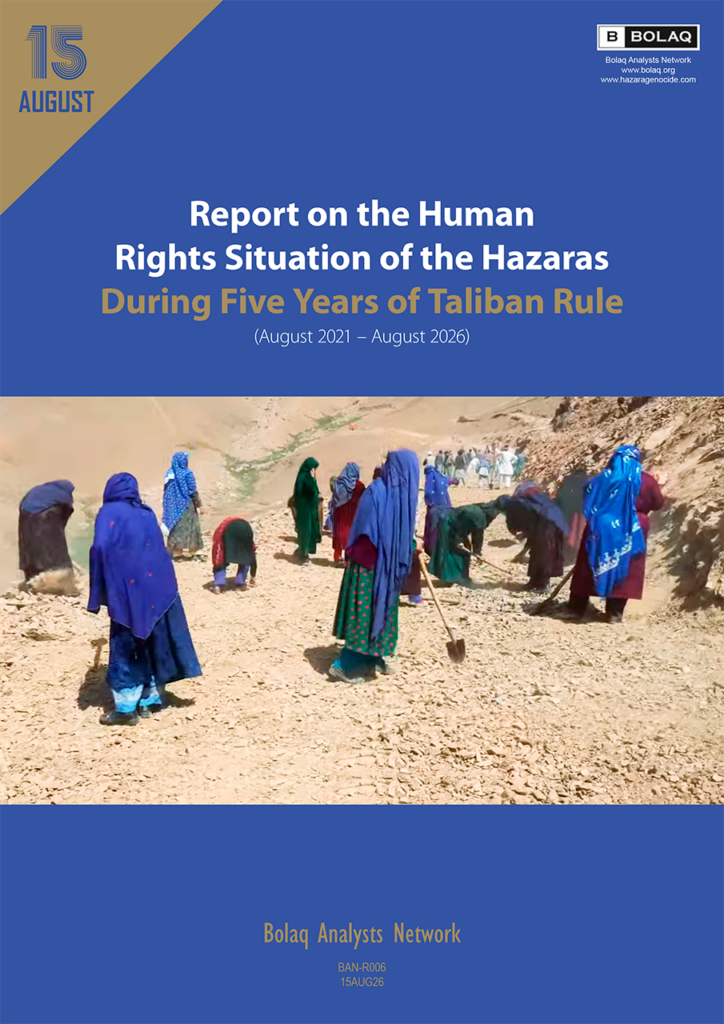

The present report is the result of a comprehensive and documented study of the situation of the Hazara community in Afghanistan during the five years of Taliban rule (from August 2021 to August 2026).
Bolaq Report – The Situation of the Hazaras During the Fourth Year of the Taliban Rule [ English | Dari ]
The return of the Taliban to power in Afghanistan in August 2021 marked a profound transformation in the country’s political, social, and security environment. For the Hazara community, one of Afghanistan’s historically marginalized ethnic and religious minorities, the Taliban’s return has generated renewed concerns about discrimination, insecurity, and the erosion of fundamental rights. The Hazaras, who historically experienced persecution under successive Afghan governments and armed groups, entered the Taliban’s second period of rule with memories of systematic violence and exclusion. Although the Taliban have publicly presented themselves as a government committed to security and stability, the experiences of Hazaras during the first five years of Taliban rule raise important questions about whether their community has achieved meaningful protection, political inclusion, and social equality.
Since 2021, Hazara communities have faced a complex combination of security threats, political marginalization, restrictions on education and employment, and broader limitations on civil and religious freedoms. Attacks against Hazara civilians, particularly those claimed by or attributed to Islamic State Khorasan Province (ISKP), have continued in schools, mosques, educational centers, and other public spaces. At the same time, concerns have emerged regarding forced displacement, land disputes, and the loss of political representation. The Taliban’s governance has also affected Hazara women and girls through restrictions that aHazaras Afghan women more broadly, including limitations on education, employment, and participation in public life. These developments are significant because they demonstrate that the situation of the Hazaras cannot be understood solely through the question of physical security; it must also be examined through the wider framework of political participation, socioeconomic rights, religious freedom, and access to justice.
The first five years of Taliban rule therefore provide an important period for examining the changing position of the Hazara community in Afghanistan. This period allows observers to assess the gap between the Taliban’s promises of security and inclusive governance and the realities experienced by minority communities. It also provides an opportunity to examine how historical patterns of discrimination interact with contemporary political structures and security challenges.
This research paper examines the situation of the Hazaras during the first five years of Taliban rule, focusing particularly on security, political exclusion, socioeconomic conditions, religious freedom, and human rights. It seeks to assess the major challenges confronting the Hazara community and to explore how Taliban governance has influenced their position within Afghan society. By examining these developments, the study aims to contribute to a broader understanding of minority rights and the consequences of Taliban rule for one of Afghanistan’s most vulnerable communities.