

Press Release
January 25, 2026
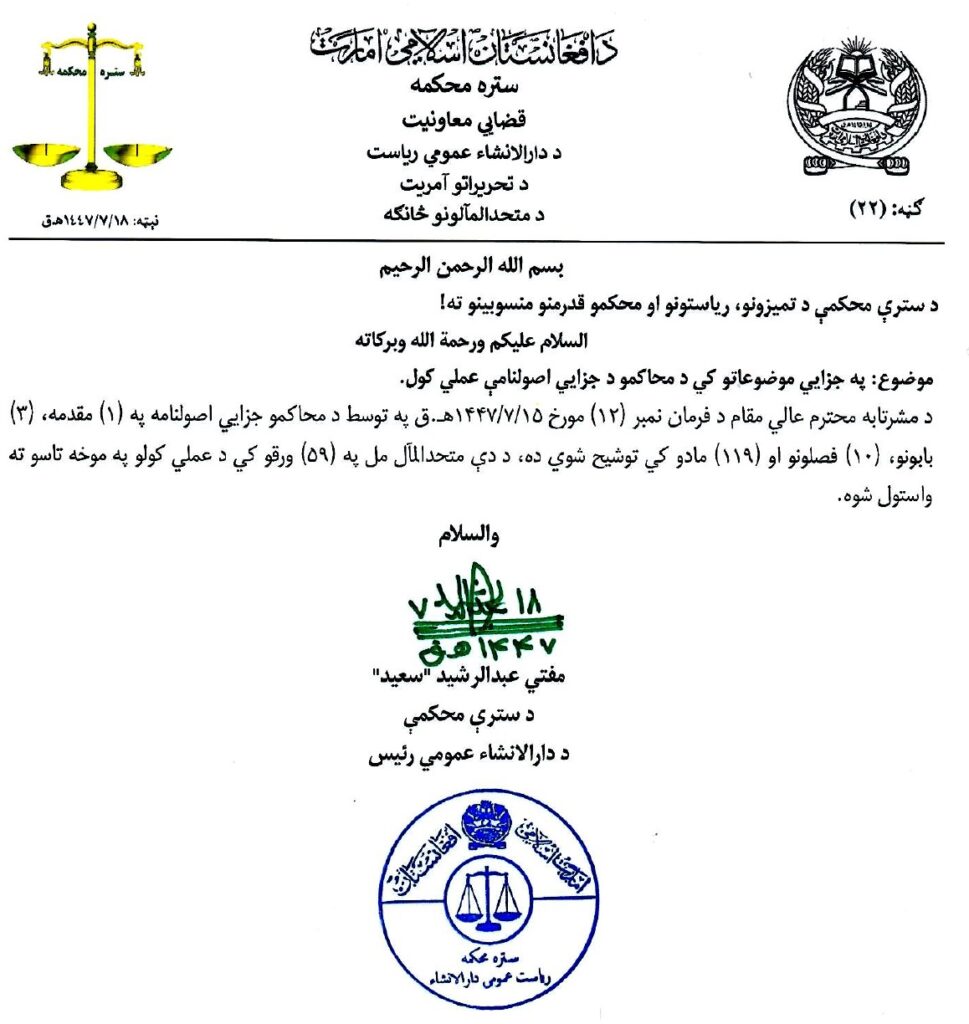
The Bolaq Analysts Network (Bolaq), as an independent human rights institution, condemns in the strongest possible terms the Taliban’s issuance of the new “Criminal Court Principles.” The content of this recently ratified document is not a conventional legal text, but an ideological and highly radical tool designed to consolidate authoritarian rule, systematically suppress citizens, and institutionalize injustice—particularly against women and ethnic-religious groups outside the Taliban’s ideological sphere.
Through deliberately vague and broadly interpretable phrasing, this law grants unlimited jurisdiction to the Taliban’s unilateral and non-independent courts. These courts, which lack the most basic standards of international fair trial, now have legal backing under this document for arbitrary detentions, harsh sentencing, and the suppression of dissenting voices. With this move, the Taliban are placing a superficial veil of “law” over the authoritarian and exclusionary nature of their rule, thereby jeopardizing legal security for all the people of Afghanistan.
The Bolaq Analysts Network emphasizes with deep concern that this law explicitly places women in an unprecedented state of vulnerability, paving the way for their complete deprivation of the right to seek justice and subjecting them to cruel punishments based on extremist interpretations. This practice constitutes a blatant violation of Afghanistan’s international obligations and fundamental human rights norms.
The most alarming and shocking aspect of this law is its explicit legitimization of slavery. By incorporating this issue into certain provisions, particularly Article 15, the Taliban have not only mocked international law but also ridiculed a century of humanity’s efforts to abolish this abhorrent practice. This move primarily targets the Hazara community, which in contemporary Afghanistan history—especially during the reign of Abdul Rahman Khan (Amir of Afghanistan from 1880 to his death in 1901) — fell victim to state-sponsored slavery policies. Legalizing this issue is akin to pouring salt on the old wounds of the Hazara people and represents a calculated attempt to intensify their humiliation, isolation, and collective suffering.
The Bolaq Analysts Network raises the serious question of whether the deliberate intent behind this action is to create conditions of severe hardship for a specific ethnic-religious group. According to Article 2 of the Convention on the Prevention and Punishment of the Crime of Genocide, acts intended to inflict severe physical or mental suffering on members of a group, with the intent to destroy that group, in whole or in part, may constitute genocide.
Furthermore, in Article 9 of this law, the Taliban have effectively divided Afghanistan citizens into two classes: those who are “privileged and permanently immune” and those treated as “perpetual potential criminals.” This practice not only violates the fundamental principle of equality before the law but also undermines any foundation for peaceful coexistence and a unified future for Afghanistan.
The Bolaq Analysts Network calls on the international community, the United Nations, human rights institutions, and all UN member states to:
- Explicitly and unequivocally condemn this inhumane law that violates human dignity.
- Intensify political, economic, and diplomatic pressure on the Taliban to immediately repeal this law and all discriminatory regulations.
- Urgently review their Responsibility to Protect (R2P) obligations under the Genocide Convention regarding the situation of ethnic-religious groups, particularly the Hazaras, in Afghanistan.
- Refrain from recognizing or normalizing relations with a regime that systematically ratifies and implements anti-humanitarian laws.
We reiterate our warning: Silence in the face of such oppressive laws constitutes complicity in oppression and contributes to the destruction of Afghanistan’s future. The conscience of humanity must not remain silent in the face of the official return of slavery to the 21st century.
Bolaq Analysts Network